Introduction
The African Women and Children Empowerment Initiative eV (AWCEI) deployed two short-term election observers to the general elections in Liberia, held on October 10, 2023. This observer mission was conducted with the accreditation granted by the National Election Committee of Liberia (NEC), under the authority of Hon Daviedetta Brown Lansanah. This report provides an overview of our general observations, focusing on the period from October 9th to October 10th, 2023, covering both the day before the elections and the election day itself. The report follows the prescribed structure, including the location information of the polling stations, opening procedures, general observations, gender and special groups’ perspectives, potential threats to peace at the polling stations, and the overall observations made by the AWCEI Observer team. Our report aims to present an empirical account of the observers’ experiences without offering overarching analyses of the elections.
Observers’ Conduct
AWCEI observers conducted their duties as impartial, objective, and passive observers. They refrained from intervening in or participating in any voting activities at the polling stations and avoided discussions of political topics with voters. As directed by NEC, our observers had unrestricted access to the polling stations. Over the course of Election Day, they visited multiple polling stations in three voting districts, including two in the interior of Monrovia and one in Margibi County.
Observers Team
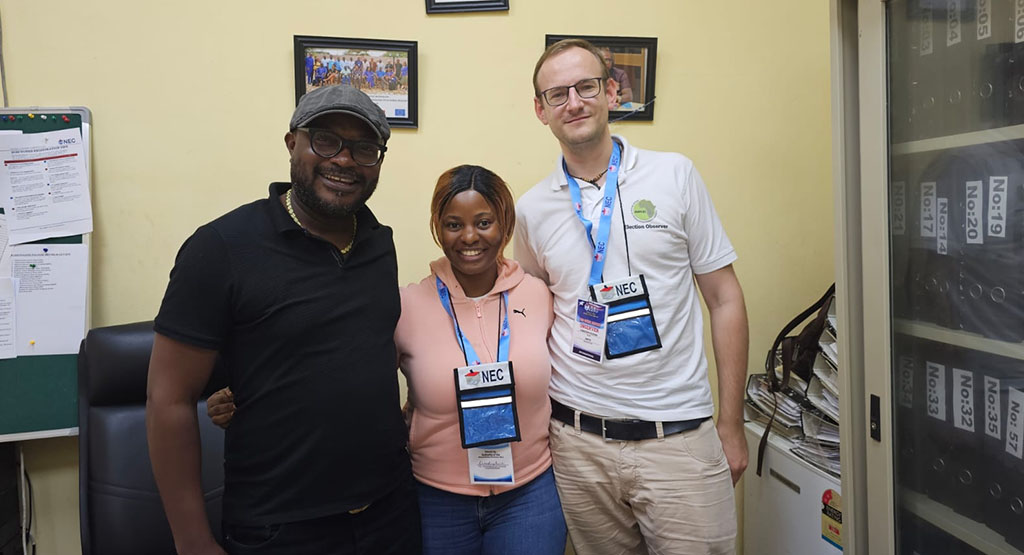
AWCEI’s observers team consisted of two members, Nalowa Bih Nsoh and Christoph Kühne. The team hired the services of a local driver who assisted them in reaching the polling stations. Due to limited personnel and unfamiliarity with the area, our team covered 11 polling stations between 6 AM and 6 PM.
Electoral Administration
The NEC demonstrated operational unpreparedness as they faced delays, errors, and omissions in the delivery of sensitive election materials on Election Day. Some NEC staff expressed the inadequacy of resources, particularly for logistics and voter education. Also noticeable was the lack of transparency in the publication of NEC decisions, regulations, procedures, and minutes, which hindered scrutiny of the decision-making processes, potentially undermining regional and international commitments to access to information and institutional accountability. AWCEI observers received sensitive materials such as tags, voting district maps, and conduct code brochures only on the eve of the voting day. The voting conditions for national observers was also only resolved on the eve of the voting day and this organisational lapse was also attributed to delayed funding.
Electoral Materials
While all polling stations were provided with voting materials (mainly voting slips and ballot boxes), the delivery of these materials were often delayed, which slowed down the voting process. The polling stations observed by AWCEI accommodated 1,500 to 4,000 registered voters each, with 3 to 6 voting rooms, with each room containing 1 to 3 voting booths. The voting slips were unwrapped in sets of approximately 58 voting slips per set. However, some sets did not have up to 58 voting slips, and this affected the counting process after polls closed. Insufficient lighting in two polling stations led to voters using mobile phone torches to read the voting slips, as well as hampered the counting of votes after 6 PM. In three polling stations, inadequate ventilation, and lighting, coupled with cramped conditions, posed security risks and inconveniences to voters. In one polling station, accessibility issues were observed, indicating potential challenges for voters in more rural areas.
Security Staff
Security staff were present in all polling stations observed by AWCEI, and they generally did not interfere with the voting process. However, tensions arose in six out of the eleven polling stations, primarily in Monrovia’s urban areas, due to long queues, lack of shelter from the hot sun, and food shortages. In some instances, the observer team had to conclude their observations early due to these tensions and the inadequate efforts made by security staff to maintain order. In three polling stations, voters complained about individuals bypassing queues and entering voting stations under the protection of security personnel. Such instances of trespassing raised concerns about election security and impartiality.
Voting Staff
All observed polling stations were adequately staffed, and the staff demonstrated their commitment to maintaining electoral standards. In eight out of the eleven polling stations observed, elderly and disabled voters received assistance from polling staff. However, there was inconsistency in adherence to the requirement for AWCEI observers to place their signature in the presence book, which undermined trust in the election staff. Tensions increased in the late afternoon as voters who had been waiting since early morning worried about not being able to cast their votes before the 6 PM closing time. The voting staff did not adequately inform voters that those in line by 6 PM would still be allowed to vote. Interestingly, in one polling station, where conditions were especially challenging for voters, the crowded queue had disappeared after the AWCEI observer team returned just two hours after they left.
Women and People with Special Needs
Our observations revealed mixed experiences for women and people with special needs at different polling stations. Voting staff assisted elderly individuals and those with disabilities, but in crowded queues, their ability to provide assistance decreased. Many polling stations presented obstacles for physically challenged voters, such as stairs, poor lighting, and difficult accessibility. The voters most affected with people with disabilities, pregnant women, and those with children. Due to the requirement for citizens to vote at their registered polling stations, heavy rainfall and bad road conditions prevented many from reaching their designated polling places, restricting their voting opportunities.
Final Observations
The 2023 general elections in Liberia were characterized by slow processing by the voting staff and the resulting overwhelmingly long queues at polling stations, with voters waiting long hours and some failing to vote. Inadequate shelter from the sun exacerbated the situation. Tensions increased as the polls’ closure approached, with insufficient information about voting times provided to those already in the queue. Security presence was not optimal to manage the number of voters, leading to further tensions and complaints about queue-jumpers.
While the elections were mostly peaceful, the electoral process was marred by inadequate preparation to handle the large voter turnout. AWCEI recommends that the NEC secures funding for the 2029 national elections well in advance to enable efficient planning. This should include better education of both voting staff and citizens to avoid misunderstandings about the voting process, particularly regarding voting after the 6 PM poll closing time. Additionally, accessibility issues at polling stations should be addressed to ensure that all citizens, irrespective of their physical condition, can exercise their right to vote. Despite these challenges, AWCEI acknowledges the peaceful conduct of the 2023 general elections in Liberia.
African Women and Children Empowerment Initiative eV
October 19, 2023